
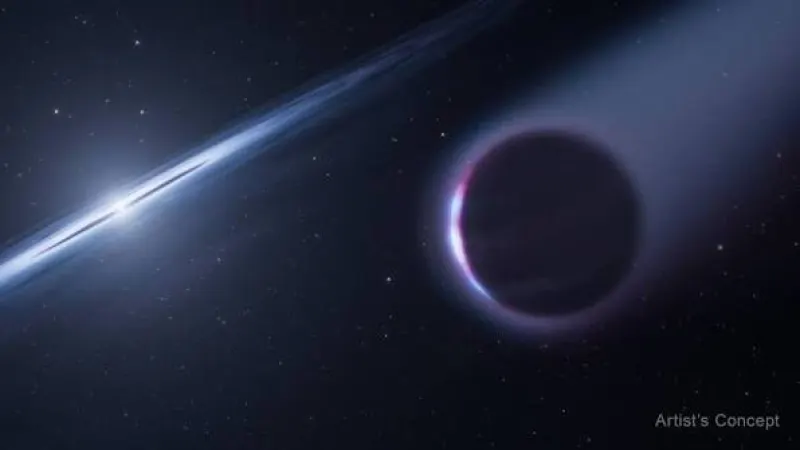
A gas giant may have been born after its star was already dead. The hypothesis appears in a NASA study published in Nature Astronomy on October 5, 2026 and reported by ScienceDaily on October 9. Researchers identified an unusual chemical signature of niobium, a rare metal, in the HS 0209+0832 system, captured by the Hubble Space Telescope and the FUSE observatory. The most plausible reading is that this material was ejected during the star's death and later accumulated to form a new planet. TESS data reinforces the suspicion: there is a Jupiter-sized body orbiting about 6 million kilometers from the white dwarf.
Niobium drew attention precisely because it is an atypical signature in dead stars. According to the study, the presence of the metal indicates that it did not come from the system's original material but from something formed more recently around the white dwarf. Combined observations from Hubble and FUSE, which cover complementary ultraviolet ranges, allowed isolation of this chemical trace. In parallel, TESS, the NASA satellite specialized in finding exoplanets, detected the Jupiter-sized object in a very close orbit. This distance is a small fraction of the roughly 150 million kilometers that separate Earth from the Sun.
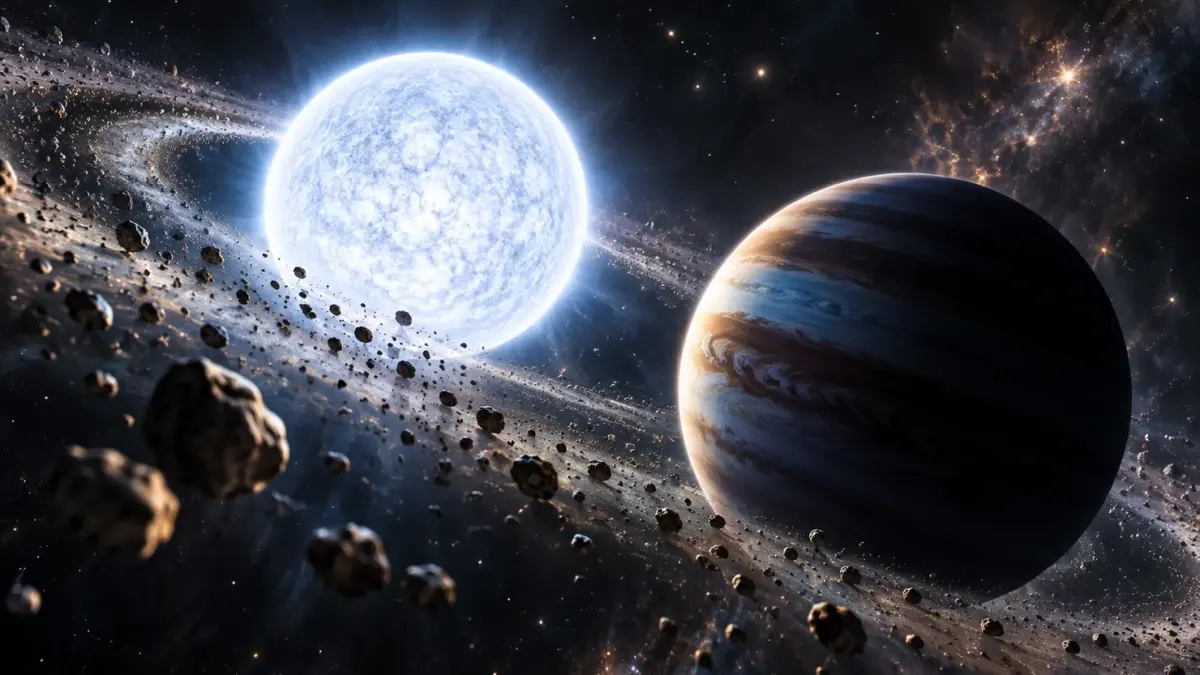
White dwarfs are the dense remnants of Sun-like stars that exhausted their nuclear fuel and expelled their outer layers. In this process, nearby planets are usually swallowed or destroyed, leaving behind a compact, bright core. That is why the idea of a "second-generation" planet is so unusual: instead of forming with the star, it would have formed from the debris left by the star's own death. If confirmed, the HS 0209+0832 case would show that planet formation can occur even around the corpse of a stellar system. The scenario is analogous to the disks that give rise to planets around young stars.
Confirming the nature of the body indicated by TESS will depend on new observations. The combination of the niobium signature and the very close orbit is the main evidence that this is a newly formed planet rather than a survivor from the system's original era. Discoveries of this kind help project the fate of systems like our own, since the Sun is also expected to become a white dwarf in the distant future. Understanding whether worlds can be reborn after stellar death broadens the search for planets in environments previously ruled out. The full article appeared in Nature Astronomy, with highlights from NASA and coverage in ScienceDaily.
Comments 0
Login to Comment
You need to be logged in to join the discussion
Loading comments...
No comments yet
Login to be the first to comment!