
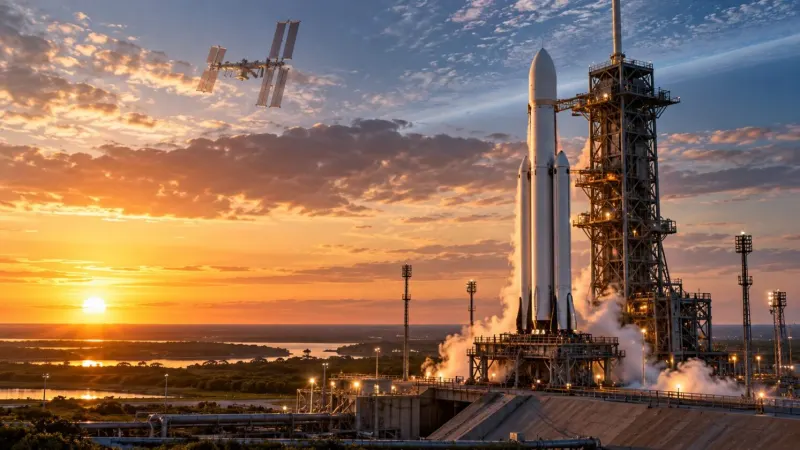
SpaceX has liftoff scheduled for 6:33 a.m. EDT this Tuesday (13) — 7:33 a.m. Brasília time —, when the Falcon 9 lifts off from Cape Canaveral, Florida, carrying the Dragon capsule of the CRS-35 mission. The destination is the International Space Station, which receives another load of supplies and science amid routine operations. The cargo totals more than 2,800 kg and includes health research and the station's latest Roll-Out Solar Arrays. The information comes from NASA and Spaceflight Now. Missions like this rarely make headlines, but they are what keep the station inhabited and operational.
More than 2,800 kg travel inside the Dragon, divided between provisions, support equipment and scientific investigations. The highlight goes to the health research, which takes advantage of microgravity to observe the human body in conditions impossible to reproduce in terrestrial laboratories. Studies of this kind help prepare crews for increasingly long stays in space. The load is completed with maintenance items and consumable materials used in the crew's daily routine. It is unglamorous cargo, but without it the ISS simply stops.
The most symbolic item in the batch, however, are the Roll-Out Solar Arrays. With this delivery, the station receives the last panels of this type planned for its power set. The name already reveals how they work: instead of unfolding like drawers like conventional arrays, they roll out in orbit, like a carpet extended from the ISS structure. The compact format facilitates transport inside the capsule and installation on site. In practice, the new panels expand the energy generation available to sustain experiments and onboard systems.
CRS-35 is part of the Commercial Resupply Services program, through which NASA hires private companies to carry cargo to the station. SpaceX is the most frequent operator of this scheme, and the Dragon flying on this mission is the cargo version, without crew. With no astronauts on board, practically the entire volume of the capsule is dedicated to payload. After liftoff, the Dragon heads to the ISS, where it remains docked while the crew unloads the items and prepares it to return to Earth with experiment results. The cycle has repeated for years and has become the backbone of U.S. orbital logistics.
For NASA, each flight of this type is a key piece to keep science running in low orbit. The health research of CRS-35 follows this line, turning the station into a laboratory of conditions that Earth does not offer. With the final solar panels on the way, the ISS secures energy breath for the years of operation ahead. The Tuesday launch also reinforces SpaceX's role as a routine supplier — and no longer an exception — in access to space. Tavern4 follows the mission and brings updates as the Dragon approaches the station.
Comments 0
Login to Comment
You need to be logged in to join the discussion
Loading comments...
No comments yet
Login to be the first to comment!