
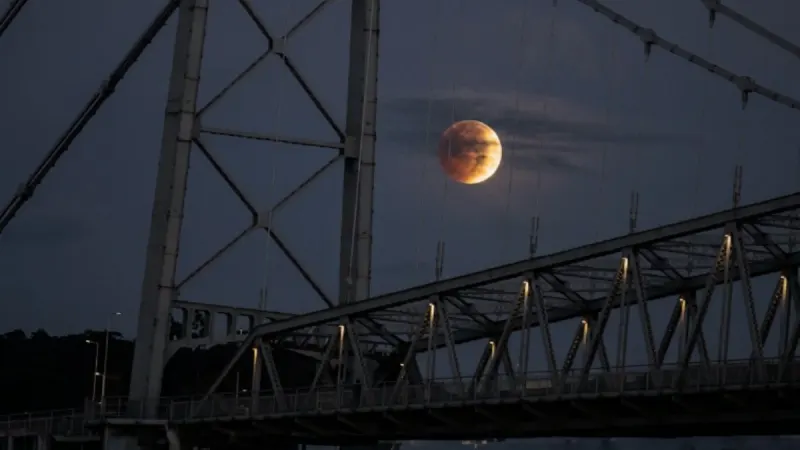
In the early morning of this Friday, August 28, 2026, Brazil witnessed a deep partial lunar eclipse, with 96.2% of the lunar disk covered by the Earth's umbra. The phenomenon reached its maximum around 1:13 AM (Brasília time), when the Full Moon displayed a characteristic reddish coloration. According to the Observatório Nacional, the event was visible throughout the national territory, without the need for special equipment for observation. NASA and Timeanddate confirmed the data, highlighting the magnitude of the eclipse. For many, it was a unique opportunity to appreciate the beauty of the night sky.
A lunar eclipse occurs when the Earth positions itself between the Sun and the Moon, casting its shadow over the natural satellite. In this event, 96.2% of the lunar disk entered the darkest region of the shadow, the umbra, characterizing a deep partial eclipse. Although not total, the covered portion was sufficient to create an impressive visual effect, with the Moon taking on tones ranging from grayish to reddish. PortalR3 highlighted that the phenomenon began around midnight and extended for a few hours, with the maximum occurring in the early morning. The Full Moon, already a spectacle in itself, became even more special during the eclipse.
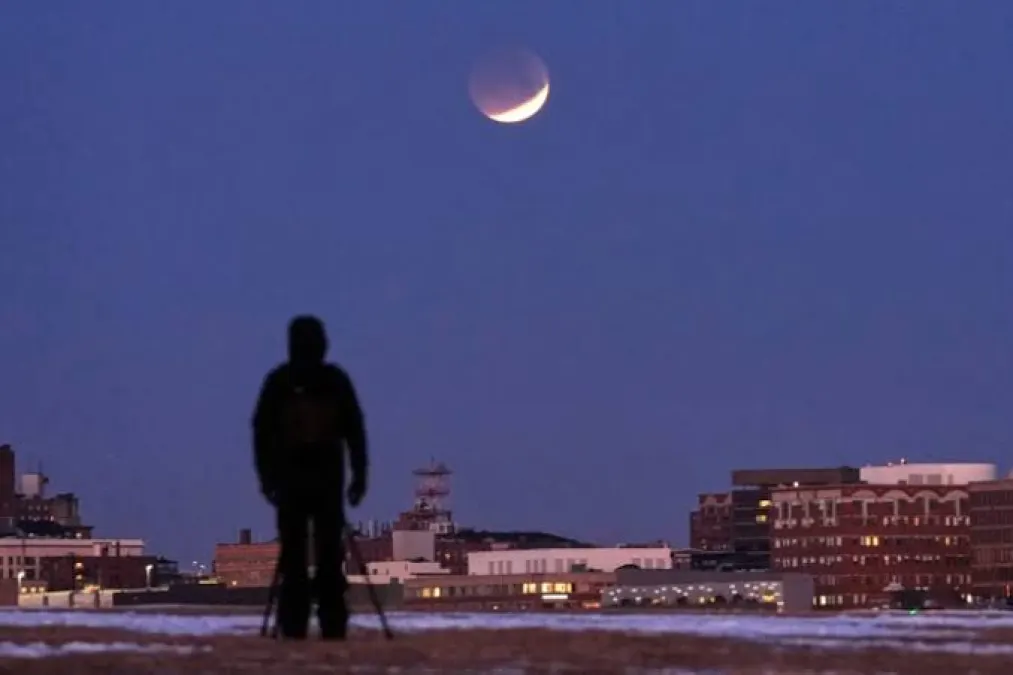
For Brazilian observers, the eclipse was a gift from the sky, as the entire country could follow the phenomenon with the naked eye. Unlike solar eclipses, there is no risk of vision damage, allowing entire families to step outside or look through windows. In some regions, clear skies favored observation, while others had to deal with clouds, but the event remained visible for the most part. The Observatório Nacional recommended that interested parties seek locations with low light pollution for a better experience. For those who missed it, video recordings and photos are still available on social media to enjoy.
This was the second partial lunar eclipse of 2026, and the next event of this type is scheduled for a few years from now. Amateur and professional astronomers took the opportunity to study the interaction between sunlight and the Earth's atmosphere, which causes the reddish coloration. According to NASA, observing eclipses helps in understanding atmospheric phenomena and calibrating instruments. For the general public, it leaves the memory of a memorable early morning that united science and natural beauty. Those who did not see it can follow upcoming astronomical events in advance, such as announcements from the Observatório Nacional.
Comments 0
Login to Comment
You need to be logged in to join the discussion
Loading comments...
No comments yet
Login to be the first to comment!