

The Tiangong Ultra, a humanoid robot developed by the Beijing Humanoid Robot Innovation Center, crossed the 100-meter finish line in 9.39 seconds during the qualifying round of the World Humanoid Robot Games, held this Saturday (22) at the National Speed Skating Oval in Beijing. The time surpassed Usain Bolt's world record of 9.58 seconds, set in 2009 in Berlin. The mark was confirmed by the Chinese state news agency Xinhua and echoed in the international press. The robot, which stands 1.69 meters tall, had already impressed in previous tests with 9.32 seconds. The maximum speed reached was 14.5 meters per second, equivalent to 52.2 km/h, according to CCTV information.
The World Humanoid Robot Games, running until August 26, bring together 2,056 robots from 666 teams across 16 countries. The competition includes 51 events, with 30 based on traditional sports and 21 simulating real-world tasks such as folding clothes and connecting cables. More than 40% of the events require the robots to operate fully autonomously, according to Huawei, the event's technology partner. In athletics, the humanoids also broke the 400-meter record with a time of 38.15 seconds, surpassing Wayde van Niekerk's mark. The second edition of the event, held at the same stadium used for the 2022 Winter Olympics, serves as a showcase for China's advances in robotics and artificial intelligence.
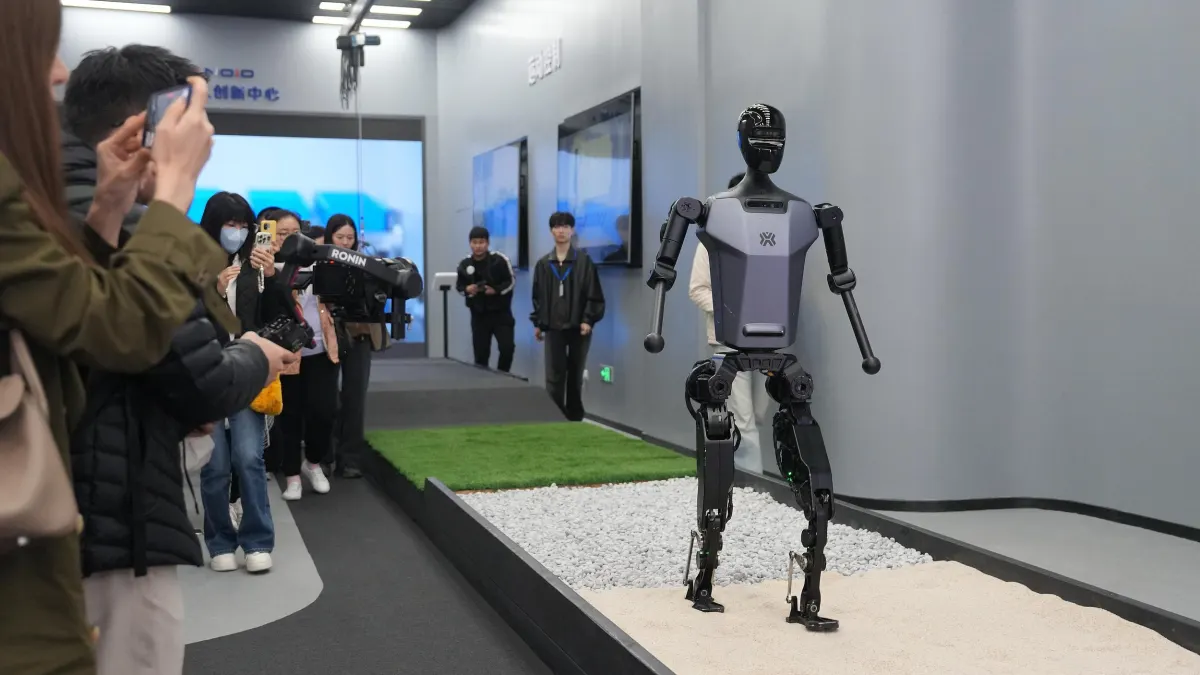
The Tiangong Ultra is linked to Honor, the Chinese smartphone manufacturer, which also developed the Lightning robot that won the Beijing Half Marathon in April with a time of 50 minutes and 26 seconds. After the race, researchers extended Lightning's legs by 10 centimeters to 1.05 meters to improve performance at the Games. Another standout company is Unitree, which recently went public on the Shanghai Stock Exchange and reached a valuation of about US$ 50 billion, according to Reuters. Its 'Superman' robot has demonstrated a speed of 12.66 meters per second and a two-meter jump. The presence of these companies highlights heavy private-sector investment in humanoid robotics in China.
Despite the records, the robots still struggle to stop after the finish line. Videos shared on social media show several humanoids colliding with protective barriers, falling, and even catching fire, drawing laughter from the audience. Retired 72-year-old Hou Yali said the achievements left her curious to see a matchup between machines and humans. 'We will be able to see more clearly if the machines can surpass humans,' she told UOL. Meanwhile, experts note that the Games aim beyond speed, testing autonomy and adaptation to everyday tasks. The competition, ending on Wednesday, is expected to continue breaking records and sparking debates about the future of robotics.
Comments 0
Login to Comment
You need to be logged in to join the discussion
Loading comments...
No comments yet
Login to be the first to comment!